English
 Arabic
 French
 Spanish
 Portuguese
 Deutsch
 Turkish
 Dutch
Dutch
 Italiano
 Russian
 Romaian
 Portuguese (Brazil)
 Greek
Greek

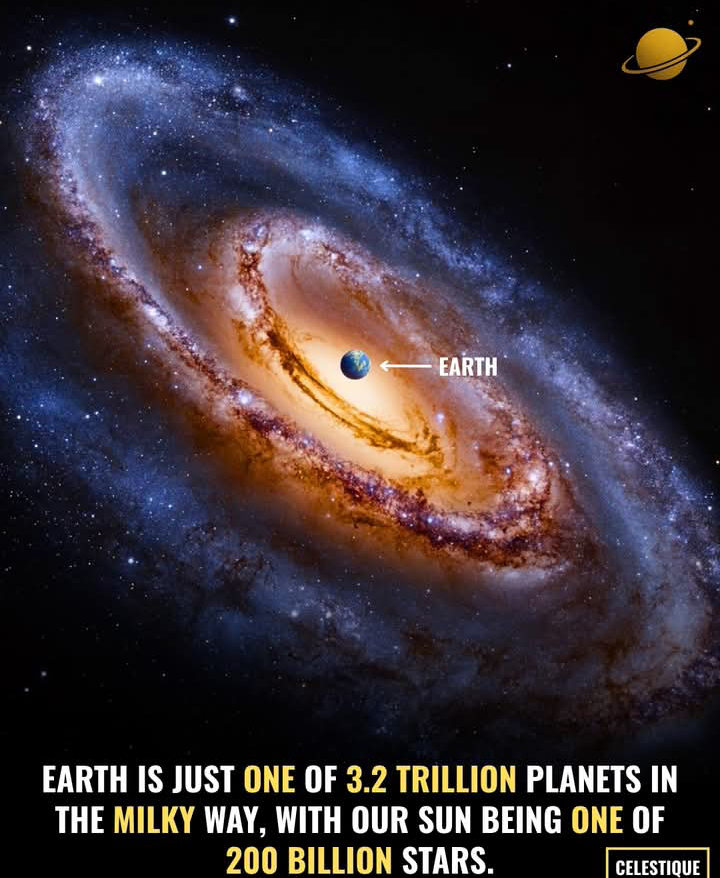
When you think about Earth, it’s easy to assume we are at the center of the universe. However, the truth is much more humbling. Our planet is just one of an estimated 3.2 trillion planets orbiting stars in our Milky Way galaxy. To put this into perspective, our galaxy alone contains over 200 billion stars, with our Sun being just one among them. The Milky Way is just one of the 2 trillion galaxies in the observable universe, each with its own countless stars and planets, making the scale of the cosmos mind-boggling.
Earth, as significant as it may feel to us, is a small part of a much grander cosmic system. The Milky Way, our home galaxy, spans over 100,000 light-years across and contains billions of planets, most of which remain undiscovered. It’s a reminder that the universe is far more expansive than we can ever truly comprehend. The numbers are so large, they become almost abstract, reminding us how tiny we really are in the grand scheme of things.
Our Sun, which provides the energy necessary for life on Earth, is just one of the 200 billion stars in the Milky Way. Many of these stars have planets of their own, potentially supporting life. Yet, despite the staggering number of planets and stars, only a tiny fraction have been explored, and only a handful are known to host conditions suitable for life. This opens up an exciting avenue for future space exploration, where the discovery of exoplanets is just beginning.
On a universal scale, our galaxy is one of over 2 trillion galaxies within the observable universe. Each galaxy, like the Milky Way, contains billions of stars and potentially trillions of planets, creating a vast and diverse cosmos. This enormity suggests that the possibilities for life beyond Earth are far more extensive than we have ever imagined. It also underscores how much more there is to learn about the universe and our place within it.
When we look up at the stars, it's easy to get lost in the beauty and mystery of the night sky. But the reality is even more profound. Earth, our home, is just a small, delicate dot in a vast universe, where billions of other worlds are waiting to be discovered. The more we understand about the cosmos, the more we realize how interconnected everything is and how much more there is to explore. Our journey in space exploration is just beginning.
Earth, as significant as it may feel to us, is a small part of a much grander cosmic system. The Milky Way, our home galaxy, spans over 100,000 light-years across and contains billions of planets, most of which remain undiscovered. It’s a reminder that the universe is far more expansive than we can ever truly comprehend. The numbers are so large, they become almost abstract, reminding us how tiny we really are in the grand scheme of things.
Our Sun, which provides the energy necessary for life on Earth, is just one of the 200 billion stars in the Milky Way. Many of these stars have planets of their own, potentially supporting life. Yet, despite the staggering number of planets and stars, only a tiny fraction have been explored, and only a handful are known to host conditions suitable for life. This opens up an exciting avenue for future space exploration, where the discovery of exoplanets is just beginning.
On a universal scale, our galaxy is one of over 2 trillion galaxies within the observable universe. Each galaxy, like the Milky Way, contains billions of stars and potentially trillions of planets, creating a vast and diverse cosmos. This enormity suggests that the possibilities for life beyond Earth are far more extensive than we have ever imagined. It also underscores how much more there is to learn about the universe and our place within it.
When we look up at the stars, it's easy to get lost in the beauty and mystery of the night sky. But the reality is even more profound. Earth, our home, is just a small, delicate dot in a vast universe, where billions of other worlds are waiting to be discovered. The more we understand about the cosmos, the more we realize how interconnected everything is and how much more there is to explore. Our journey in space exploration is just beginning.
When you think about Earth, it’s easy to assume we are at the center of the universe. However, the truth is much more humbling. Our planet is just one of an estimated 3.2 trillion planets orbiting stars in our Milky Way galaxy. To put this into perspective, our galaxy alone contains over 200 billion stars, with our Sun being just one among them. The Milky Way is just one of the 2 trillion galaxies in the observable universe, each with its own countless stars and planets, making the scale of the cosmos mind-boggling.
Earth, as significant as it may feel to us, is a small part of a much grander cosmic system. The Milky Way, our home galaxy, spans over 100,000 light-years across and contains billions of planets, most of which remain undiscovered. It’s a reminder that the universe is far more expansive than we can ever truly comprehend. The numbers are so large, they become almost abstract, reminding us how tiny we really are in the grand scheme of things.
Our Sun, which provides the energy necessary for life on Earth, is just one of the 200 billion stars in the Milky Way. Many of these stars have planets of their own, potentially supporting life. Yet, despite the staggering number of planets and stars, only a tiny fraction have been explored, and only a handful are known to host conditions suitable for life. This opens up an exciting avenue for future space exploration, where the discovery of exoplanets is just beginning.
On a universal scale, our galaxy is one of over 2 trillion galaxies within the observable universe. Each galaxy, like the Milky Way, contains billions of stars and potentially trillions of planets, creating a vast and diverse cosmos. This enormity suggests that the possibilities for life beyond Earth are far more extensive than we have ever imagined. It also underscores how much more there is to learn about the universe and our place within it.
When we look up at the stars, it's easy to get lost in the beauty and mystery of the night sky. But the reality is even more profound. Earth, our home, is just a small, delicate dot in a vast universe, where billions of other worlds are waiting to be discovered. The more we understand about the cosmos, the more we realize how interconnected everything is and how much more there is to explore. Our journey in space exploration is just beginning.

·118 Views
·0 Reviews