English
 Arabic
 French
 Spanish
 Portuguese
 Deutsch
 Turkish
 Dutch
Dutch
 Italiano
 Russian
 Romaian
 Portuguese (Brazil)
 Greek
Greek

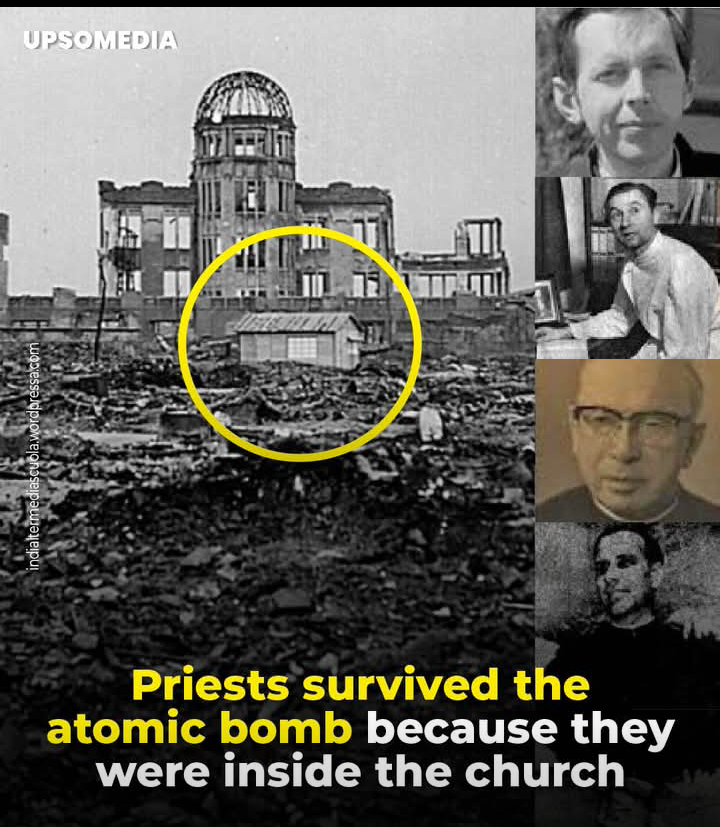
In Hiroshima, less than 1 kilometer from the epicenter of the atomic bomb, there was a house where four Jesuit priests lived. They never imagined that on August 6, 1945, when the city was wiped out in seconds, they would survive. Their names were Hugo Lassalle, Hubert Schiffer, Wilhelm Kleinsorge, and Johannes Siemes. While everything around them was reduced to ashes, their home—partially damaged—remained standing. None of them died from the explosion or developed the typical effects of radiation that affected thousands of people in the following years. The case was investigated for decades by doctors and scientists because it defied all statistical probability. The priests themselves said they had been fasting and praying that morning. For some, it was pure structural coincidence; for others, an impossible-to-ignore coincidence.
In Hiroshima, less than 1 kilometer from the epicenter of the atomic bomb, there was a house where four Jesuit priests lived. They never imagined that on August 6, 1945, when the city was wiped out in seconds, they would survive. Their names were Hugo Lassalle, Hubert Schiffer, Wilhelm Kleinsorge, and Johannes Siemes. While everything around them was reduced to ashes, their home—partially damaged—remained standing. None of them died from the explosion or developed the typical effects of radiation that affected thousands of people in the following years. The case was investigated for decades by doctors and scientists because it defied all statistical probability. The priests themselves said they had been fasting and praying that morning. For some, it was pure structural coincidence; for others, an impossible-to-ignore coincidence.

1 Comments
·95 Views
·0 Reviews