English
 Arabic
 French
 Spanish
 Portuguese
 Deutsch
 Turkish
 Dutch
Dutch
 Italiano
 Russian
 Romaian
 Portuguese (Brazil)
 Greek
Greek

Did You Know? IP Addresses Have Classes!
How devices find each other on the internet? It all starts with an IP address — a unique identifier for every device online!
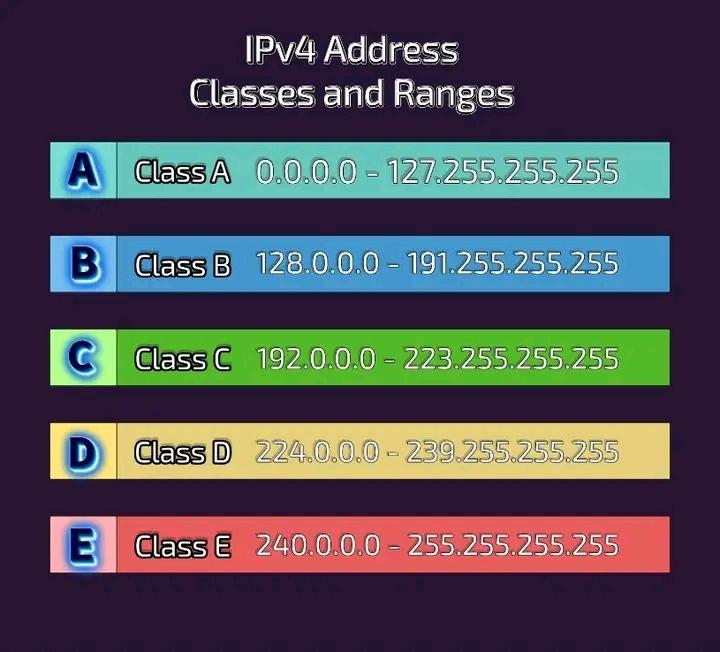
Back in the day, IPv4 addresses were split into 5 classes to manage networks of different sizes:
Class A: 0.0.0.0 – 127.255.255.255
→ For huge networks (think big corporations!)
Class B: 128.0.0.0 – 191.255.255.255
→ Perfect for medium-sized networks (like universities)
Class C: 192.0.0.0 – 223.255.255.255
→ Ideal for small networks (your home Wi-Fi!)
Class D: 224.0.0.0 – 239.255.255.255
→ Used for multicast (one-to-many communication)
Class E: 240.0.0.0 – 255.255.255.255
→ Reserved for experiments & future tech
Fun Fact: Today, we mostly use CIDR (Classless Inter-Domain Routing) for smarter, more efficient IP allocation!
#TechTalk #Networking #IPAddress #IPv4 #ClassA #ClassB #ClassC #CIDR #LearnTech #InternetBasics
How devices find each other on the internet? It all starts with an IP address — a unique identifier for every device online!
Back in the day, IPv4 addresses were split into 5 classes to manage networks of different sizes:
Class A: 0.0.0.0 – 127.255.255.255
→ For huge networks (think big corporations!)
Class B: 128.0.0.0 – 191.255.255.255
→ Perfect for medium-sized networks (like universities)
Class C: 192.0.0.0 – 223.255.255.255
→ Ideal for small networks (your home Wi-Fi!)
Class D: 224.0.0.0 – 239.255.255.255
→ Used for multicast (one-to-many communication)
Class E: 240.0.0.0 – 255.255.255.255
→ Reserved for experiments & future tech
Fun Fact: Today, we mostly use CIDR (Classless Inter-Domain Routing) for smarter, more efficient IP allocation!
#TechTalk #Networking #IPAddress #IPv4 #ClassA #ClassB #ClassC #CIDR #LearnTech #InternetBasics
Did You Know? IP Addresses Have Classes! 🌟
How devices find each other on the internet? It all starts with an IP address — a unique identifier for every device online!
Back in the day, IPv4 addresses were split into 5 classes to manage networks of different sizes:
🔹 Class A: 0.0.0.0 – 127.255.255.255
→ For huge networks (think big corporations!)
🔹 Class B: 128.0.0.0 – 191.255.255.255
→ Perfect for medium-sized networks (like universities)
🔹 Class C: 192.0.0.0 – 223.255.255.255
→ Ideal for small networks (your home Wi-Fi!)
🔹 Class D: 224.0.0.0 – 239.255.255.255
→ Used for multicast (one-to-many communication)
🔹 Class E: 240.0.0.0 – 255.255.255.255
→ Reserved for experiments & future tech
💡 Fun Fact: Today, we mostly use CIDR (Classless Inter-Domain Routing) for smarter, more efficient IP allocation!
#TechTalk #Networking #IPAddress #IPv4 #ClassA #ClassB #ClassC #CIDR #LearnTech #InternetBasics

·252 Views
·0 Anteprima