English
 Arabic
 French
 Spanish
 Portuguese
 Deutsch
 Turkish
 Dutch
Dutch
 Italiano
 Russian
 Romaian
 Portuguese (Brazil)
 Greek
Greek

Antimatter, Mathematics, and the Debate About Cosmic Design
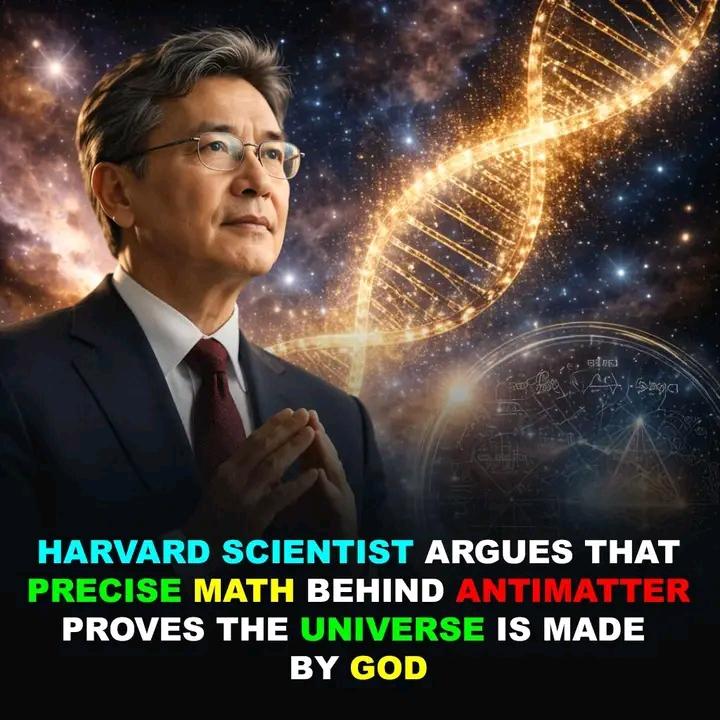
A discussion linking physics and philosophy has emerged after commentary attributed to a researcher associated with Harvard University suggested that the mathematical precision governing Antimatter could raise questions about whether the universe shows signs of intentional design.
Antimatter remains one of modern physics’ biggest puzzles. According to current cosmological models, the early universe should have produced equal amounts of matter and antimatter. When matter and antimatter meet, they destroy each other. Yet the observable universe is dominated by matter. Scientists still investigate why a tiny imbalance occurred — an imbalance that ultimately allowed galaxies, stars, planets, and life to exist.
The philosophical argument highlights how the mathematical laws describing particle behavior appear highly structured and predictable. Supporters of design-based interpretations suggest that such precision might hint at deeper meaning or intentional structure behind physical laws.
Critics, including many physicists, argue that mathematical consistency does not necessarily imply a designer. They maintain that natural laws can exist without intentional creation and that the matter–antimatter imbalance remains an open scientific question currently studied through particle physics experiments and cosmological research.
The discussion sits at the intersection of science, philosophy, and theology. While antimatter research continues to expand scientific understanding of the universe, it also fuels broader reflection on existence, origins, and the nature of cosmic order.
#Science #Physics #Antimatter #Cosmology #Philosophy #Universe
A discussion linking physics and philosophy has emerged after commentary attributed to a researcher associated with Harvard University suggested that the mathematical precision governing Antimatter could raise questions about whether the universe shows signs of intentional design.
Antimatter remains one of modern physics’ biggest puzzles. According to current cosmological models, the early universe should have produced equal amounts of matter and antimatter. When matter and antimatter meet, they destroy each other. Yet the observable universe is dominated by matter. Scientists still investigate why a tiny imbalance occurred — an imbalance that ultimately allowed galaxies, stars, planets, and life to exist.
The philosophical argument highlights how the mathematical laws describing particle behavior appear highly structured and predictable. Supporters of design-based interpretations suggest that such precision might hint at deeper meaning or intentional structure behind physical laws.
Critics, including many physicists, argue that mathematical consistency does not necessarily imply a designer. They maintain that natural laws can exist without intentional creation and that the matter–antimatter imbalance remains an open scientific question currently studied through particle physics experiments and cosmological research.
The discussion sits at the intersection of science, philosophy, and theology. While antimatter research continues to expand scientific understanding of the universe, it also fuels broader reflection on existence, origins, and the nature of cosmic order.
#Science #Physics #Antimatter #Cosmology #Philosophy #Universe
Antimatter, Mathematics, and the Debate About Cosmic Design
A discussion linking physics and philosophy has emerged after commentary attributed to a researcher associated with Harvard University suggested that the mathematical precision governing Antimatter could raise questions about whether the universe shows signs of intentional design.
Antimatter remains one of modern physics’ biggest puzzles. According to current cosmological models, the early universe should have produced equal amounts of matter and antimatter. When matter and antimatter meet, they destroy each other. Yet the observable universe is dominated by matter. Scientists still investigate why a tiny imbalance occurred — an imbalance that ultimately allowed galaxies, stars, planets, and life to exist.
The philosophical argument highlights how the mathematical laws describing particle behavior appear highly structured and predictable. Supporters of design-based interpretations suggest that such precision might hint at deeper meaning or intentional structure behind physical laws.
Critics, including many physicists, argue that mathematical consistency does not necessarily imply a designer. They maintain that natural laws can exist without intentional creation and that the matter–antimatter imbalance remains an open scientific question currently studied through particle physics experiments and cosmological research.
The discussion sits at the intersection of science, philosophy, and theology. While antimatter research continues to expand scientific understanding of the universe, it also fuels broader reflection on existence, origins, and the nature of cosmic order.
#Science #Physics #Antimatter #Cosmology #Philosophy #Universe
·238 Views
·0 voorbeeld