Upgrade to Pro

  • ACCOUNTING VS AUDITING VS FINANCE

    ACCOUNTING:
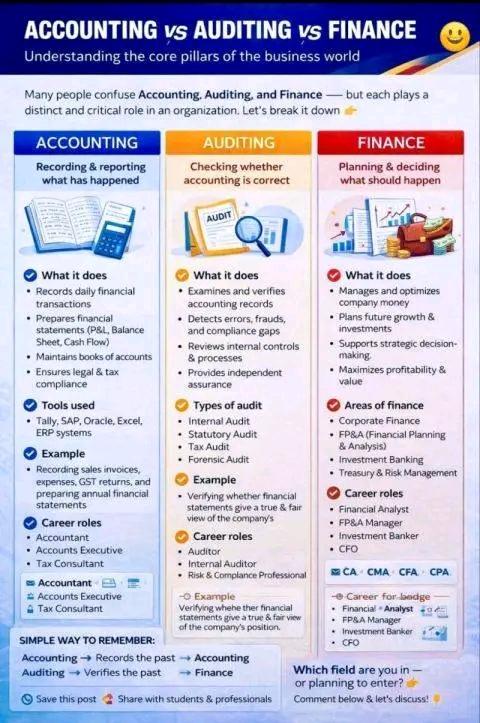
    Accounting is the systematic recording and reporting of financial transactions. It ensures the business has accurate books and financial statements.

    Key activities:
    • Recording daily transactions
    • Preparing trial balance
    • Preparing financial statements
    • Managing payables/receivables
    • Costing, budgeting, payroll

    Source: Accounting involves recording and processing financial data systematically.

    AUDITING:
    Auditing is the independent examination of financial statements to ensure they are accurate and comply with standards.

    Key activities:
    • Checking internal controls
    • Verifying transactions and balances
    • Ensuring compliance with IFRS/ISA
    • Issuing an audit opinion
    Source: Auditing verifies that financial data is correct and compliant with standards.

    FINANCE:
    Finance deals with managing money, making investment decisions, and planning for the future.

    Key activities:
    • Capital budgeting
    • Investment analysis
    • Risk management
    • Funding decisions (debt vs equity)
    • Cash flow forecasting
    Source: Finance is not about recording or verifying — it is about using money to create value.

    Simple Way to Remember
    • Accounting = Record the numbers
    • Auditing = Check the numbers
    • Finance = Use the numbers to make decisions
    🔶 ACCOUNTING VS AUDITING VS FINANCE 🔶 🔊 ACCOUNTING: ⬇️ 👉 Accounting is the systematic recording and reporting of financial transactions. It ensures the business has accurate books and financial statements. ➡️ Key activities: 👇 • Recording daily transactions • Preparing trial balance • Preparing financial statements • Managing payables/receivables • Costing, budgeting, payroll ▪️ Source: Accounting involves recording and processing financial data systematically. 🔊 AUDITING: ⬇️ 👉 Auditing is the independent examination of financial statements to ensure they are accurate and comply with standards. ➡️ Key activities: • Checking internal controls • Verifying transactions and balances • Ensuring compliance with IFRS/ISA • Issuing an audit opinion ▪️ Source: Auditing verifies that financial data is correct and compliant with standards. 🔊 FINANCE: ⬇️ 👉 Finance deals with managing money, making investment decisions, and planning for the future. ➡️ Key activities: • Capital budgeting • Investment analysis • Risk management • Funding decisions (debt vs equity) • Cash flow forecasting ▪️ Source: Finance is not about recording or verifying — it is about using money to create value. 🧠 Simple Way to Remember • Accounting = Record the numbers • Auditing = Check the numbers • Finance = Use the numbers to make decisions
    ·58 Views ·0 Reviews
  • The Story of Assets and Liabilities

    At 25, Daniel got his first good job.

    Every month, his salary came in on the 25th.
    By the 10th of the next month, it was gone.

    Daniel thought he was building wealth.

    He bought a new car on loan.
    A bigger apartment.
    Latest gadgets.

    On paper, his life looked successful.

    But every month, money left him faster than it arrived.

    Those things were not helping him earn more.
    They only demanded fuel, rent, repairs, and repayments.

    Daniel owned them.
    But they owned his cash flow.

    Those were liabilities.

    At 30, Daniel met a friend, Tunde.

    Tunde earned less than Daniel.
    But Tunde always had money.

    Tunde explained one idea.

    “An asset puts money in your pocket.
    A liability takes money out.”

    Tunde showed him his finances.

    A small rental apartment paying monthly rent.
    Shares paying dividends.
    A side business generating steady cash.

    Nothing flashy.
    But money flowed in consistently.

    Those were assets.

    Daniel changed strategy.

    He sold what drained him.
    He kept what paid him.

    Five years later, his income did not change much.
    But his stress disappeared.

    Because assets paid his bills.
    Liabilities demanded his salary.

    The Lesson

    Assets buy freedom.
    Liabilities buy appearance.

    If it does not put money in your pocket,
    it is costing you time.

    #Accounting Knowledge Concepts
    The Story of Assets and Liabilities At 25, Daniel got his first good job. Every month, his salary came in on the 25th. By the 10th of the next month, it was gone. Daniel thought he was building wealth. He bought a new car on loan. A bigger apartment. Latest gadgets. On paper, his life looked successful. But every month, money left him faster than it arrived. Those things were not helping him earn more. They only demanded fuel, rent, repairs, and repayments. Daniel owned them. But they owned his cash flow. Those were liabilities. At 30, Daniel met a friend, Tunde. Tunde earned less than Daniel. But Tunde always had money. Tunde explained one idea. “An asset puts money in your pocket. A liability takes money out.” Tunde showed him his finances. A small rental apartment paying monthly rent. Shares paying dividends. A side business generating steady cash. Nothing flashy. But money flowed in consistently. Those were assets. Daniel changed strategy. He sold what drained him. He kept what paid him. Five years later, his income did not change much. But his stress disappeared. Because assets paid his bills. Liabilities demanded his salary. The Lesson Assets buy freedom. Liabilities buy appearance. If it does not put money in your pocket, it is costing you time. #Accounting Knowledge Concepts
    Like
    Love
    2
    ·136 Views ·0 Reviews
  • A practical guide for beginners, business owners, and young accountants

    Many people read a profit and loss statement but ignore the cash flow statement. Yet this report reveals the real truth about a company’s health: is cash actually coming in, or is the business quietly dying?

    Here is exactly how to analyse it step by step:

    Start with Operating Activities
    This is the most important section. It shows whether the company’s core business generates cash or consumes it.

    What to check:
    • Is operating cash flow positive or negative?
    • Is it increasing or declining year after year?
    • Is it strong enough to cover daily expenses without borrowing?

    Red flag: A company with profit but negative operating cash flow is in danger.

    Compare Operating Cash Flow to Net Profit
    This helps you detect accounting tricks or unsustainable earnings.

    If operating cash flow is consistently lower than profit, the company’s reported profit may not be real.

    Green signal: Cash flow > Net profit
    Warning signal: Cash flow < Net profit over several periods

    Check Investing Activities
    This section shows how the company grows.

    Positive investing cash flow usually means the company is selling assets.
    Negative investing cash flow often means the company is buying new assets for expansion.

    What to check:
    • Is the company investing in productive assets or selling off assets to survive?
    • Is the investment consistent with long-term growth?

    Red flag: Continually selling assets to create cash.

    Review Financing Activities
    Here you see how the company is funded.

    Positive financing cash flow: raising money from loans or issuing shares.
    Negative financing cash flow: paying debts, paying interest, or paying dividends.

    What to check:
    • Is the company depending too much on loans to stay alive?
    • Is debt repayment affecting available cash?
    • Are dividends draining cash while operations are weak?

    Red flag: The company survives only through borrowing.

    Evaluate the Net Cash Movement
    This is the final summary of all the above.

    Ask:
    • Did total cash increase or decrease?
    • Is the cash balance enough for short-term obligations?
    • Is the trend stable over several years?

    Green signal: Strong, stable, increasing cash balance.
    Warning signal: Declining cash despite strong revenue.

    Check Cash Flow Ratios (Simple But Powerful)
    Operating Cash Flow Ratio:
    Operating Cash Flow / Current Liabilities
    This shows if cash coming in can pay short-term obligations.

    Cash Conversion Ratio:
    Operating Cash Flow / Net Income
    This shows how real the company’s profit is.

    Look for Patterns Over 3 to 5 Years
    Never judge with one period.
    Trends tell the real story.

    Questions to ask:
    • Is operating cash flow consistent?
    • Are investments strategic?
    • Is financing showing dependence or stability?

    Link Cash Flow to Business Reality
    Cash flow never works alone. Compare it with:
    • Revenue trends
    • Expenses
    • Profit margins
    • Debt levels
    • Asset growth

    This gives you the full picture of financial strength.

    Summary: What Good Cash Flow Looks Like
    • Positive operating cash flow
    • Reasonable, strategic investments
    • Controlled financing activities
    • Increasing cash balance year after year
    • Cash flow supporting profit, not contradicting it

    A practical guide for beginners, business owners, and young accountants Many people read a profit and loss statement but ignore the cash flow statement. Yet this report reveals the real truth about a company’s health: is cash actually coming in, or is the business quietly dying? Here is exactly how to analyse it step by step: Start with Operating Activities This is the most important section. It shows whether the company’s core business generates cash or consumes it. What to check: • Is operating cash flow positive or negative? • Is it increasing or declining year after year? • Is it strong enough to cover daily expenses without borrowing? Red flag: A company with profit but negative operating cash flow is in danger. Compare Operating Cash Flow to Net Profit This helps you detect accounting tricks or unsustainable earnings. If operating cash flow is consistently lower than profit, the company’s reported profit may not be real. Green signal: Cash flow > Net profit Warning signal: Cash flow < Net profit over several periods Check Investing Activities This section shows how the company grows. Positive investing cash flow usually means the company is selling assets. Negative investing cash flow often means the company is buying new assets for expansion. What to check: • Is the company investing in productive assets or selling off assets to survive? • Is the investment consistent with long-term growth? Red flag: Continually selling assets to create cash. Review Financing Activities Here you see how the company is funded. Positive financing cash flow: raising money from loans or issuing shares. Negative financing cash flow: paying debts, paying interest, or paying dividends. What to check: • Is the company depending too much on loans to stay alive? • Is debt repayment affecting available cash? • Are dividends draining cash while operations are weak? Red flag: The company survives only through borrowing. Evaluate the Net Cash Movement This is the final summary of all the above. Ask: • Did total cash increase or decrease? • Is the cash balance enough for short-term obligations? • Is the trend stable over several years? Green signal: Strong, stable, increasing cash balance. Warning signal: Declining cash despite strong revenue. Check Cash Flow Ratios (Simple But Powerful) Operating Cash Flow Ratio: Operating Cash Flow / Current Liabilities This shows if cash coming in can pay short-term obligations. Cash Conversion Ratio: Operating Cash Flow / Net Income This shows how real the company’s profit is. Look for Patterns Over 3 to 5 Years Never judge with one period. Trends tell the real story. Questions to ask: • Is operating cash flow consistent? • Are investments strategic? • Is financing showing dependence or stability? Link Cash Flow to Business Reality Cash flow never works alone. Compare it with: • Revenue trends • Expenses • Profit margins • Debt levels • Asset growth This gives you the full picture of financial strength. Summary: What Good Cash Flow Looks Like • Positive operating cash flow • Reasonable, strategic investments • Controlled financing activities • Increasing cash balance year after year • Cash flow supporting profit, not contradicting it
    ·168 Views ·0 Reviews
  • 𝗜𝗡𝗧𝗥𝗢𝗗𝗨𝗖𝗧𝗜𝗢𝗡 𝗧𝗢 𝗔𝗖𝗖𝗢𝗨𝗡𝗧𝗜𝗡𝗚

    Accounting is the language of business. It helps you record, classify, and summarize financial transactions so you can understand the performance and financial health of any organization. Whether you are a student, entrepreneur, or professional, mastering accounting gives you control over money and better decision making.

    𝗪𝗵𝘆 𝗜𝘁 𝗠𝗮𝘁𝘁𝗲𝗿𝘀
    • It helps track income and expenses
    • It supports planning, budgeting, and forecasting
    • It ensures compliance with laws and standards
    • It reveals profit, cash flow, and financial strength
    • It allows owners and managers to make informed decisions

    𝗠𝗮𝗶𝗻 𝗔𝗿𝗲𝗮𝘀 𝗼𝗳 𝗔𝗰𝗰𝗼𝘂𝗻𝘁𝗶𝗻𝗴
    • Financial accounting
    • Management accounting
    • Cost accounting
    • Taxation
    • Auditing

    When you grasp the basics, the rest becomes easier. One of the fundamental building blocks of accounting is the concept of Debits and Credits.

    𝗨𝗡𝗗𝗘𝗥𝗦𝗧𝗔𝗡𝗗𝗜𝗡𝗚 𝗗𝗘𝗕𝗜𝗧𝗦 𝗔𝗡𝗗 𝗖𝗥𝗘𝗗𝗜𝗧𝗦

    Every transaction has two sides. One account is debited and another is credited. This is what keeps the accounting equation in balance:

    Assets = Liabilities + Equity

    𝗛𝗲𝗿𝗲 𝗶𝘀 𝗵𝗼𝘄 𝗗𝗲𝗯𝗶𝘁𝘀 𝗮𝗻𝗱 𝗖𝗿𝗲𝗱𝗶𝘁𝘀 𝗪𝗼𝗿𝗸

    1️⃣ Assets
    • Debit increases
    • Credit decreases
    Example buying equipment for cash increases Equipment (debit) and decreases Cash (credit)

    2️⃣ Liabilities
    • Debit decreases
    • Credit increases
    Example taking a loan increases Loan Payable (credit)

    3️⃣ Equity
    • Debit decreases
    • Credit increases
    Example owner investing capital increases Equity (credit)

    4️⃣ Revenue
    • Debit decreases
    • Credit increases
    Example making sales increases Revenue (credit)

    5️⃣ Expenses
    • Debit increases
    • Credit decreases
    Example paying rent increases Rent Expense (debit)

    𝗦𝗶𝗺𝗽𝗹𝗲 𝗪𝗮𝘆 𝗧𝗼 𝗥𝗲𝗺𝗲𝗺𝗯𝗲𝗿
    Assets and Expenses increase on the Debit side
    Liabilities Equity and Revenue increase on the Credit side

    𝗘𝘅𝗮𝗺𝗽𝗹𝗲 𝗧𝗿𝗮𝗻𝘀𝗮𝗰𝘁𝗶𝗼𝗻
    You receive cash for a sale
    Debit Cash
    Credit Sales Revenue

    𝗞𝗲𝘆 𝗧𝗮𝗸𝗲𝗮𝘄𝗮𝘆
    Debits and credits are not good or bad. They are simply tools to keep the books balanced and ensure that every transaction is recorded correctly. Master these and you can understand any accounting system with confidence.

    #everyone Accounting Knowledge Concepts
    𝗜𝗡𝗧𝗥𝗢𝗗𝗨𝗖𝗧𝗜𝗢𝗡 𝗧𝗢 𝗔𝗖𝗖𝗢𝗨𝗡𝗧𝗜𝗡𝗚 Accounting is the language of business. It helps you record, classify, and summarize financial transactions so you can understand the performance and financial health of any organization. Whether you are a student, entrepreneur, or professional, mastering accounting gives you control over money and better decision making. 𝗪𝗵𝘆 𝗜𝘁 𝗠𝗮𝘁𝘁𝗲𝗿𝘀 • It helps track income and expenses • It supports planning, budgeting, and forecasting • It ensures compliance with laws and standards • It reveals profit, cash flow, and financial strength • It allows owners and managers to make informed decisions 𝗠𝗮𝗶𝗻 𝗔𝗿𝗲𝗮𝘀 𝗼𝗳 𝗔𝗰𝗰𝗼𝘂𝗻𝘁𝗶𝗻𝗴 • Financial accounting • Management accounting • Cost accounting • Taxation • Auditing When you grasp the basics, the rest becomes easier. One of the fundamental building blocks of accounting is the concept of Debits and Credits. 𝗨𝗡𝗗𝗘𝗥𝗦𝗧𝗔𝗡𝗗𝗜𝗡𝗚 𝗗𝗘𝗕𝗜𝗧𝗦 𝗔𝗡𝗗 𝗖𝗥𝗘𝗗𝗜𝗧𝗦 Every transaction has two sides. One account is debited and another is credited. This is what keeps the accounting equation in balance: Assets = Liabilities + Equity 𝗛𝗲𝗿𝗲 𝗶𝘀 𝗵𝗼𝘄 𝗗𝗲𝗯𝗶𝘁𝘀 𝗮𝗻𝗱 𝗖𝗿𝗲𝗱𝗶𝘁𝘀 𝗪𝗼𝗿𝗸 1️⃣ Assets • Debit increases • Credit decreases Example buying equipment for cash increases Equipment (debit) and decreases Cash (credit) 2️⃣ Liabilities • Debit decreases • Credit increases Example taking a loan increases Loan Payable (credit) 3️⃣ Equity • Debit decreases • Credit increases Example owner investing capital increases Equity (credit) 4️⃣ Revenue • Debit decreases • Credit increases Example making sales increases Revenue (credit) 5️⃣ Expenses • Debit increases • Credit decreases Example paying rent increases Rent Expense (debit) 𝗦𝗶𝗺𝗽𝗹𝗲 𝗪𝗮𝘆 𝗧𝗼 𝗥𝗲𝗺𝗲𝗺𝗯𝗲𝗿 Assets and Expenses increase on the Debit side Liabilities Equity and Revenue increase on the Credit side 𝗘𝘅𝗮𝗺𝗽𝗹𝗲 𝗧𝗿𝗮𝗻𝘀𝗮𝗰𝘁𝗶𝗼𝗻 You receive cash for a sale Debit Cash Credit Sales Revenue 𝗞𝗲𝘆 𝗧𝗮𝗸𝗲𝗮𝘄𝗮𝘆 Debits and credits are not good or bad. They are simply tools to keep the books balanced and ensure that every transaction is recorded correctly. Master these and you can understand any accounting system with confidence. #everyone Accounting Knowledge Concepts
    Like
    1
    ·273 Views ·0 Reviews
  • ACCOUNTING vs AUDIT — The Perfect Balance for Every Business
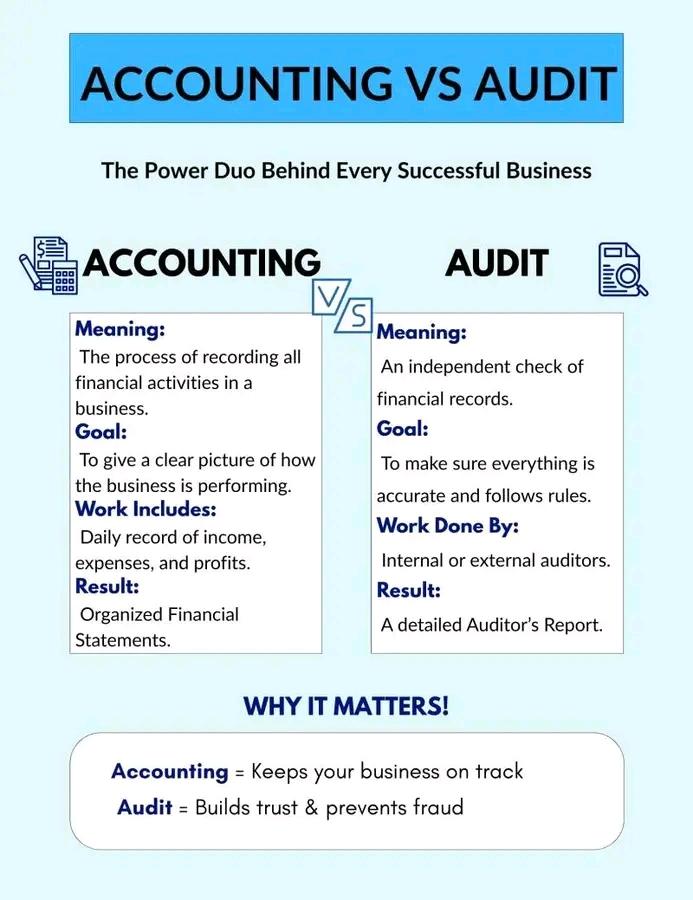
    Accounting keeps your business on track by recording every financial activity — giving you a clear picture of performance and growth.
    Audit ensures those records are accurate, compliant, and trustworthy — protecting your business from errors and fraud.
    Together, they form the backbone of financial transparency and success!

    #accounting
    ACCOUNTING vs AUDIT — The Perfect Balance for Every Business ⚖️ 🔹 Accounting keeps your business on track by recording every financial activity — giving you a clear picture of performance and growth. 🔹 Audit ensures those records are accurate, compliant, and trustworthy — protecting your business from errors and fraud. 💼 Together, they form the backbone of financial transparency and success! #accounting
    Love
    1
    ·219 Views ·0 Reviews
  • Basic Accounting Terms – A Quick Guide for Beginners!

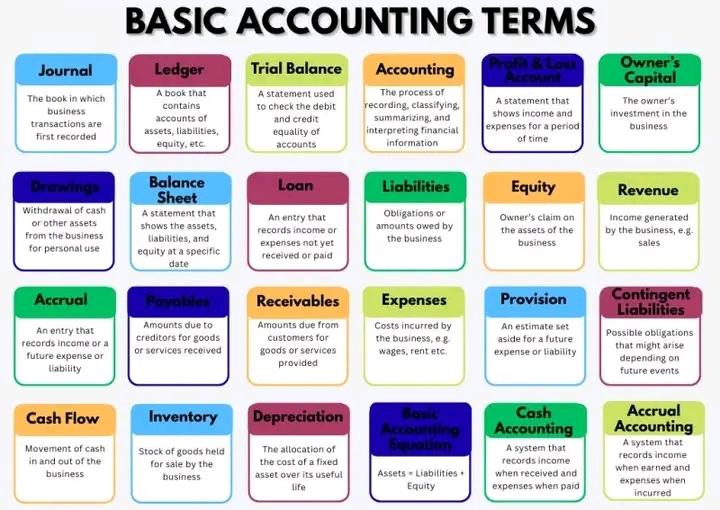
    Understanding accounting starts with knowing the key terms. Here are the most important concepts every student, entrepreneur, and professional should know — from Journal and Ledger to Cash Flow and Depreciation.
    These fundamentals help you record, track, and understand the financial health of any business.

    Perfect for beginners, accounting students, and anyone looking to build a strong foundation!

    #accounting
    📘 Basic Accounting Terms – A Quick Guide for Beginners! Understanding accounting starts with knowing the key terms. Here are the most important concepts every student, entrepreneur, and professional should know — from Journal and Ledger to Cash Flow and Depreciation. These fundamentals help you record, track, and understand the financial health of any business. Perfect for beginners, accounting students, and anyone looking to build a strong foundation! #accounting
    ·173 Views ·0 Reviews
  • A landmark 15-year study published in JAMA Internal Medicine delivers a sobering message: added sugar may pose a greater threat to heart health than cholesterol—more than doubling the risk of death from heart disease, even among people who aren’t overweight.

    The researchers found that individuals who consumed 25% or more of their daily calories from added sugar had over twice the risk of dying from heart disease compared with those who kept intake below 10%. Alarmingly, this risk rose steadily as sugar consumption increased, regardless of age, body weight, cholesterol levels, or physical activity.

    So where is all this sugar coming from? Mostly from everyday foods and drinks—sugary beverages (the largest contributor, accounting for over one-third of added sugar in the U.S. diet), along with desserts, candy, sweetened cereals, and fruit drinks. Excess sugar raises blood pressure and prompts the liver to release harmful fats into the bloodstream, both of which significantly accelerate heart disease.

    The American Heart Association recommends strict daily limits: no more than 6 teaspoons of added sugar for women and 9 for men. Yet just one can of soda can exceed those limits in a matter of minutes.

    Health experts emphasize that small changes can make a big difference—choosing sparkling water with fruit instead of soda, and opting for fresh fruit or unsweetened options in place of sugar-laden desserts—to help safeguard the heart before lasting damage occurs.
    A landmark 15-year study published in JAMA Internal Medicine delivers a sobering message: added sugar may pose a greater threat to heart health than cholesterol—more than doubling the risk of death from heart disease, even among people who aren’t overweight. The researchers found that individuals who consumed 25% or more of their daily calories from added sugar had over twice the risk of dying from heart disease compared with those who kept intake below 10%. Alarmingly, this risk rose steadily as sugar consumption increased, regardless of age, body weight, cholesterol levels, or physical activity. So where is all this sugar coming from? Mostly from everyday foods and drinks—sugary beverages (the largest contributor, accounting for over one-third of added sugar in the U.S. diet), along with desserts, candy, sweetened cereals, and fruit drinks. Excess sugar raises blood pressure and prompts the liver to release harmful fats into the bloodstream, both of which significantly accelerate heart disease. The American Heart Association recommends strict daily limits: no more than 6 teaspoons of added sugar for women and 9 for men. Yet just one can of soda can exceed those limits in a matter of minutes. Health experts emphasize that small changes can make a big difference—choosing sparkling water with fruit instead of soda, and opting for fresh fruit or unsweetened options in place of sugar-laden desserts—to help safeguard the heart before lasting damage occurs.
    ·170 Views ·0 Reviews
  • What I’m about to show you now is the real formula for escaping poverty permanently, even if your income is small.

    Oya sit down…

    Let me open your eyes with the same wisdom I used to rescue myself years ago.

    This one is not motivation.

    This is survival.

    Before I start....

    Let me tell you the truth that Nobody Tells Low-income Earners

    Poverty does not start from your bank account.

    It starts from your structure.

    Even if you earn ₦50k monthly,
    if your structure is wrong,
    you will still be broke at ₦500k…
    you will still be broke at ₦5 million.

    There are men earning ₦700k with nothing to show…

    And there are women earning ₦65k and quietly building wealth.

    What’s the difference?

    STRUCTURE.

    Let me explain with a simple story.

    Meet mama ngozi & mama bola

    Both of them sell vegetables.

    Both earn small profit daily.

    But their future is completely different.

    Mama Bola earns ₦3k profit daily…
    spends ₦3k daily.
    Every day, she starts from zero.

    Mama Ngozi earns ₦3k profit daily…
    saves ₦500…
    invests ₦500 in a cooperative…
    and uses the remaining ₦2k for feeding.

    Five years later?

    Mama Bola is still struggling.

    But Mama Ngozi has:

    A small emergency savings
    A cooperative contribution
    A money market fund paying her small returns
    A daughter in school learning tailoring
    Peace of mind

    Same income.
    Different structure.
    Different destiny.

    Now let me teach you how to build wealth even if you earn small.

    I call this THE SMRT FORMULA for low income (very simple)

    There are four buckets you must create.

    If you miss one, life will humble you.

    BUCKET 1: SURVIVAL (50% or less)

    This covers:

    – Feeding
    – Transport
    – Basic living
    – Rent
    – Recharge card & small small things

    The mistake people make is:
    THEY OVERFEED THIS BUCKET.

    Reduce your expenses ruthlessly.

    Cut your financial leakage:

    Impulse buying
    Data wastage
    Unnecessary subscriptions
    Lifestyle pressure

    If you don’t reduce your expenses,
    no strategy will save you.

    BUCKET 2: EMERGENCY FUND (10–20%)

    Before you invest, save yourself first.

    This is your life jacket.

    Your emergency fund must cover 3 months of expenses minimum.

    Why?

    Because the day emergency shows up
    and you no get backup,
    you will withdraw your investment in panic
    and scatter everything you’ve been building.

    Savings first.
    Investment later.

    BUCKET 3: INVESTMENTS (20–30%)

    Now, this is where wealth is created.

    And your goal is simple:

    Build assets that will pay you for the rest of your life.

    Even with small income, you can invest.

    Examples:

    Money Market Funds (ARM, Stanbic, FBNQuest, UC, Chappel Hill etc.)

    NIDF - for those who want long-term, stable, Sharia-friendly dividends
    Treasury Bills

    PPP-style infrastructure funds
    Cooperative investment

    Good stocks that pay dividends
    Dollar-cost averaging into solid funds

    Your job is not to invest BIG…

    Your job is to invest CONSISTENTLY.

    ₦5k monthly is better than “I’ll start next month.”

    BUCKET 4: SKILL GROWTH (10–20%)

    If you earn small and remain there,
    compounding will suffer.

    You must invest in the one asset with unlimited returns:

    YOUR SKILL.

    Learn skills that pay:

    – Digital marketing
    – Accounting
    – Sales
    – Copywriting
    – UI/UX
    – Product design
    – Data analysis
    – Trading & investment (the real way, not Ponzi)
    – Tech skills
    – Freelancing skills

    Every new skill you master
    automatically increases your earning power.

    The richer you want to become,
    the more valuable you must be.

    If you apply this formula for 10 straight years,
    even with small income…

    Your life will change permanently.

    Here is what will happen:

    Your savings will grow
    Your emergency fund will stabilize your life
    Your investment will start paying you
    Your skill will increase your income
    Your structure will be stronger than hardship
    You will enter Stage 2 (Security)
    And from there…
    FREEDOM becomes a matter of time

    This is how small income people become wealthy.

    Not by luck.
    Not by destiny.
    Not by “God when.”

    But by structure.

    Whether you are Mama Ngozi in the village,
    or a young graduate earning ₦45k,
    or a hustler doing business in Lagos…

    You can escape poverty.

    Not by running,
    but by planting.

    Not by shouting “God abeg,”
    but by building assets quietly.

    Not by looking rich,
    but by becoming rich.

    And it starts the moment you say:

    “Enough is enough, I must build wealth.”

    Follow me here on EarnNaija @onyema for more financial lecture like this and drop your comment below
    What I’m about to show you now is the real formula for escaping poverty permanently, even if your income is small. Oya sit down… Let me open your eyes with the same wisdom I used to rescue myself years ago. This one is not motivation. This is survival. Before I start.... Let me tell you the truth that Nobody Tells Low-income Earners Poverty does not start from your bank account. It starts from your structure. Even if you earn ₦50k monthly, if your structure is wrong, you will still be broke at ₦500k… you will still be broke at ₦5 million. There are men earning ₦700k with nothing to show… And there are women earning ₦65k and quietly building wealth. What’s the difference? STRUCTURE. Let me explain with a simple story. Meet mama ngozi & mama bola Both of them sell vegetables. Both earn small profit daily. But their future is completely different. Mama Bola earns ₦3k profit daily… spends ₦3k daily. Every day, she starts from zero. Mama Ngozi earns ₦3k profit daily… saves ₦500… invests ₦500 in a cooperative… and uses the remaining ₦2k for feeding. Five years later? Mama Bola is still struggling. But Mama Ngozi has: A small emergency savings A cooperative contribution A money market fund paying her small returns A daughter in school learning tailoring Peace of mind Same income. Different structure. Different destiny. Now let me teach you how to build wealth even if you earn small. I call this THE SMRT FORMULA for low income (very simple) There are four buckets you must create. If you miss one, life will humble you. BUCKET 1: SURVIVAL (50% or less) This covers: – Feeding – Transport – Basic living – Rent – Recharge card & small small things The mistake people make is: THEY OVERFEED THIS BUCKET. Reduce your expenses ruthlessly. Cut your financial leakage: Impulse buying Data wastage Unnecessary subscriptions Lifestyle pressure If you don’t reduce your expenses, no strategy will save you. BUCKET 2: EMERGENCY FUND (10–20%) Before you invest, save yourself first. This is your life jacket. Your emergency fund must cover 3 months of expenses minimum. Why? Because the day emergency shows up and you no get backup, you will withdraw your investment in panic and scatter everything you’ve been building. Savings first. Investment later. BUCKET 3: INVESTMENTS (20–30%) Now, this is where wealth is created. And your goal is simple: Build assets that will pay you for the rest of your life. Even with small income, you can invest. Examples: Money Market Funds (ARM, Stanbic, FBNQuest, UC, Chappel Hill etc.) NIDF - for those who want long-term, stable, Sharia-friendly dividends Treasury Bills PPP-style infrastructure funds Cooperative investment Good stocks that pay dividends Dollar-cost averaging into solid funds Your job is not to invest BIG… Your job is to invest CONSISTENTLY. ₦5k monthly is better than “I’ll start next month.” BUCKET 4: SKILL GROWTH (10–20%) If you earn small and remain there, compounding will suffer. You must invest in the one asset with unlimited returns: YOUR SKILL. Learn skills that pay: – Digital marketing – Accounting – Sales – Copywriting – UI/UX – Product design – Data analysis – Trading & investment (the real way, not Ponzi) – Tech skills – Freelancing skills Every new skill you master automatically increases your earning power. The richer you want to become, the more valuable you must be. If you apply this formula for 10 straight years, even with small income… Your life will change permanently. Here is what will happen: Your savings will grow Your emergency fund will stabilize your life Your investment will start paying you Your skill will increase your income Your structure will be stronger than hardship You will enter Stage 2 (Security) And from there… FREEDOM becomes a matter of time This is how small income people become wealthy. Not by luck. Not by destiny. Not by “God when.” But by structure. Whether you are Mama Ngozi in the village, or a young graduate earning ₦45k, or a hustler doing business in Lagos… You can escape poverty. Not by running, but by planting. Not by shouting “God abeg,” but by building assets quietly. Not by looking rich, but by becoming rich. And it starts the moment you say: “Enough is enough, I must build wealth.” Follow me here on EarnNaija @onyema for more financial lecture like this and drop your comment below
    Like
    Love
    2
    ·200 Views ·0 Reviews
  • From TIN to Tax ID: What Nigeria’s 2026 Tax Reform Means for Individuals and Businesses

    Qudus Alalafia LLM, MCIArb (UK), ACTI.

    With the coming into force of the New Tax Act in Nigeria on 1st January 2026, one of the most significant innovations is the introduction of the Tax Identification Number (Tax ID) as a unified and compulsory requirement for all taxable persons and entities in the country. Unlike the fragmented system that previously existed, where taxpayers could have multiple identifiers depending on whether they were dealing with the Federal Inland Revenue Service (FIRS), State Boards of Internal Revenue, or other agencies, the new regime establishes one harmonised and authoritative identifier.

    The uniqueness of the Tax ID lies in its universal application and its integration with existing national identity systems. For individuals, the Tax ID is designed to be linked with the National Identity Number (NIN), while for corporate bodies, it is to be tied to their Corporate Affairs Commission registration details. In effect, this removes duplication, harmonises records, and ensures that every taxpayer has a single, verifiable identity across all levels of government taxation. The Act also mandates its use in financial and economic transactions, including opening and operating bank accounts, taking out insurance, and other regulated financial services.

    The importance of the Tax ID can not be overstated. First, it is a tool for widening Nigeria’s tax base by bringing more economic actors, including those in the informal sector, into the tax net. Similarly, it enhances data integrity and reduces instances where one taxpayer is assigned multiple numbers, leading to inconsistencies and revenue leakages. Moreso, by making the tax ID mandatory for transactions with financial institutions, it creates a strong enforcement mechanism against tax evasion and under-reporting of income.

    The advantages for taxpayers are equally clear. Compliance is simplified, as one identifier can be used for filing returns, making payments, or seeking refunds, thereby reducing paperwork and bureaucratic bottlenecks. It will also ease access to financial services since banks and other institutions can verify compliance at the point of account opening. Furthermore, it supports automation, allowing digital platforms for payroll, HR, and accounting systems to integrate seamlessly with tax records.

    However, the likely implications on the existing Tax Identification Numbers (TINs) require careful attention. Current TINs are not to be discarded outright; rather, they will be migrated or reconciled into the new framework. This means that taxpayers already registered with a TIN will not need to start afresh but should ensure that their records are up-to-date for smooth transition. This reconciliation process will involve mapping existing TINs, NINs, CAC registration numbers, and bank records. While this promises efficiency in the long run, it may initially generate frictions such as duplicate records, mismatches, or delays.

    There are sundry issues that can not be ignored. For one, there is the risk of financial exclusion for persons in remote or disadvantaged areas who may find it difficult to obtain the new tax ID unless the government implements accessible registration mechanisms. Another concern is data security, since consolidating tax and identity data raises the stakes for privacy and cybersecurity. There is also the problem of touts and fraudulent agents attempting to exploit taxpayers during the registration process, hence the need for public awareness that the registration is meant to be free and conducted through official channels. Finally, enforcement will be strict since possession of a Tax ID is tied to essential financial services, but the government must strike a balance to avoid undue hardship on citizens during the transition period.

    In essence, the tax ID is a bold step in Nigeria’s tax reform process. If properly implemented, it will simplify compliance, broaden the tax net, improve enforcement, and strengthen public confidence in the system. Yet, as with every reform, its success will depend largely on effective public sensitisation, robust IT infrastructure, secure data protection, and a smooth migration plan for existing taxpayers. With January 2026 fast approaching, taxpayers, financial institutions, and legal practitioners must begin preparations now to adapt to this new regime.
    From TIN to Tax ID: What Nigeria’s 2026 Tax Reform Means for Individuals and Businesses Qudus Alalafia LLM, MCIArb (UK), ACTI. With the coming into force of the New Tax Act in Nigeria on 1st January 2026, one of the most significant innovations is the introduction of the Tax Identification Number (Tax ID) as a unified and compulsory requirement for all taxable persons and entities in the country. Unlike the fragmented system that previously existed, where taxpayers could have multiple identifiers depending on whether they were dealing with the Federal Inland Revenue Service (FIRS), State Boards of Internal Revenue, or other agencies, the new regime establishes one harmonised and authoritative identifier. The uniqueness of the Tax ID lies in its universal application and its integration with existing national identity systems. For individuals, the Tax ID is designed to be linked with the National Identity Number (NIN), while for corporate bodies, it is to be tied to their Corporate Affairs Commission registration details. In effect, this removes duplication, harmonises records, and ensures that every taxpayer has a single, verifiable identity across all levels of government taxation. The Act also mandates its use in financial and economic transactions, including opening and operating bank accounts, taking out insurance, and other regulated financial services. The importance of the Tax ID can not be overstated. First, it is a tool for widening Nigeria’s tax base by bringing more economic actors, including those in the informal sector, into the tax net. Similarly, it enhances data integrity and reduces instances where one taxpayer is assigned multiple numbers, leading to inconsistencies and revenue leakages. Moreso, by making the tax ID mandatory for transactions with financial institutions, it creates a strong enforcement mechanism against tax evasion and under-reporting of income. The advantages for taxpayers are equally clear. Compliance is simplified, as one identifier can be used for filing returns, making payments, or seeking refunds, thereby reducing paperwork and bureaucratic bottlenecks. It will also ease access to financial services since banks and other institutions can verify compliance at the point of account opening. Furthermore, it supports automation, allowing digital platforms for payroll, HR, and accounting systems to integrate seamlessly with tax records. However, the likely implications on the existing Tax Identification Numbers (TINs) require careful attention. Current TINs are not to be discarded outright; rather, they will be migrated or reconciled into the new framework. This means that taxpayers already registered with a TIN will not need to start afresh but should ensure that their records are up-to-date for smooth transition. This reconciliation process will involve mapping existing TINs, NINs, CAC registration numbers, and bank records. While this promises efficiency in the long run, it may initially generate frictions such as duplicate records, mismatches, or delays. There are sundry issues that can not be ignored. For one, there is the risk of financial exclusion for persons in remote or disadvantaged areas who may find it difficult to obtain the new tax ID unless the government implements accessible registration mechanisms. Another concern is data security, since consolidating tax and identity data raises the stakes for privacy and cybersecurity. There is also the problem of touts and fraudulent agents attempting to exploit taxpayers during the registration process, hence the need for public awareness that the registration is meant to be free and conducted through official channels. Finally, enforcement will be strict since possession of a Tax ID is tied to essential financial services, but the government must strike a balance to avoid undue hardship on citizens during the transition period. In essence, the tax ID is a bold step in Nigeria’s tax reform process. If properly implemented, it will simplify compliance, broaden the tax net, improve enforcement, and strengthen public confidence in the system. Yet, as with every reform, its success will depend largely on effective public sensitisation, robust IT infrastructure, secure data protection, and a smooth migration plan for existing taxpayers. With January 2026 fast approaching, taxpayers, financial institutions, and legal practitioners must begin preparations now to adapt to this new regime.
    Love
    2
    ·195 Views ·0 Reviews
EarnNaija https://earnnaija.com