English
 Arabic
 French
 Spanish
 Portuguese
 Deutsch
 Turkish
 Dutch
Dutch
 Italiano
 Russian
 Romaian
 Portuguese (Brazil)
 Greek
Greek




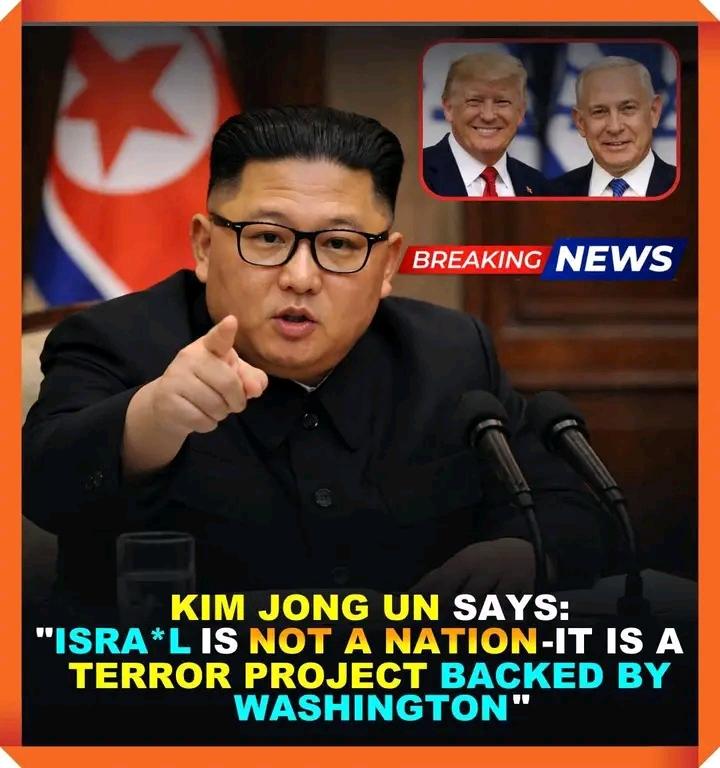
North Korean leader Kim Jong Un has sparked international debate after issuing a sharply critical statement about Israel during a period of rising tensions in the Middle East. In remarks released in December 2025, Kim reportedly characterized Israel as an “artificial terror project” backed and sustained by the United States, rejecting Israel’s legitimacy as a sovereign state and portraying it as an extension of U.S. geopolitical influence.
The comments align with North Korea’s long-standing foreign policy stance. Pyongyang has historically taken a strongly critical position toward the United States and has never formally recognized Israel. Within its ideological narrative, the North Korean government often frames global conflicts through an anti-imperialist lens, frequently voicing support for the Palestinian cause while condemning what it sees as U.S. involvement in international affairs.
While Kim’s statement does not signal any immediate policy shift or concrete action, it contributes to the increasingly
The comments align with North Korea’s long-standing foreign policy stance. Pyongyang has historically taken a strongly critical position toward the United States and has never formally recognized Israel. Within its ideological narrative, the North Korean government often frames global conflicts through an anti-imperialist lens, frequently voicing support for the Palestinian cause while condemning what it sees as U.S. involvement in international affairs.
While Kim’s statement does not signal any immediate policy shift or concrete action, it contributes to the increasingly
North Korean leader Kim Jong Un has sparked international debate after issuing a sharply critical statement about Israel during a period of rising tensions in the Middle East. In remarks released in December 2025, Kim reportedly characterized Israel as an “artificial terror project” backed and sustained by the United States, rejecting Israel’s legitimacy as a sovereign state and portraying it as an extension of U.S. geopolitical influence.
The comments align with North Korea’s long-standing foreign policy stance. Pyongyang has historically taken a strongly critical position toward the United States and has never formally recognized Israel. Within its ideological narrative, the North Korean government often frames global conflicts through an anti-imperialist lens, frequently voicing support for the Palestinian cause while condemning what it sees as U.S. involvement in international affairs.
While Kim’s statement does not signal any immediate policy shift or concrete action, it contributes to the increasingly
·37 Visualizações
·0 Anterior